
Img2threejs converter online
Img2threejs converter online
This project is scheduled for launch
Launch date: Friday, November 13, 2026 at 08:00 AM UTC
Scheduled
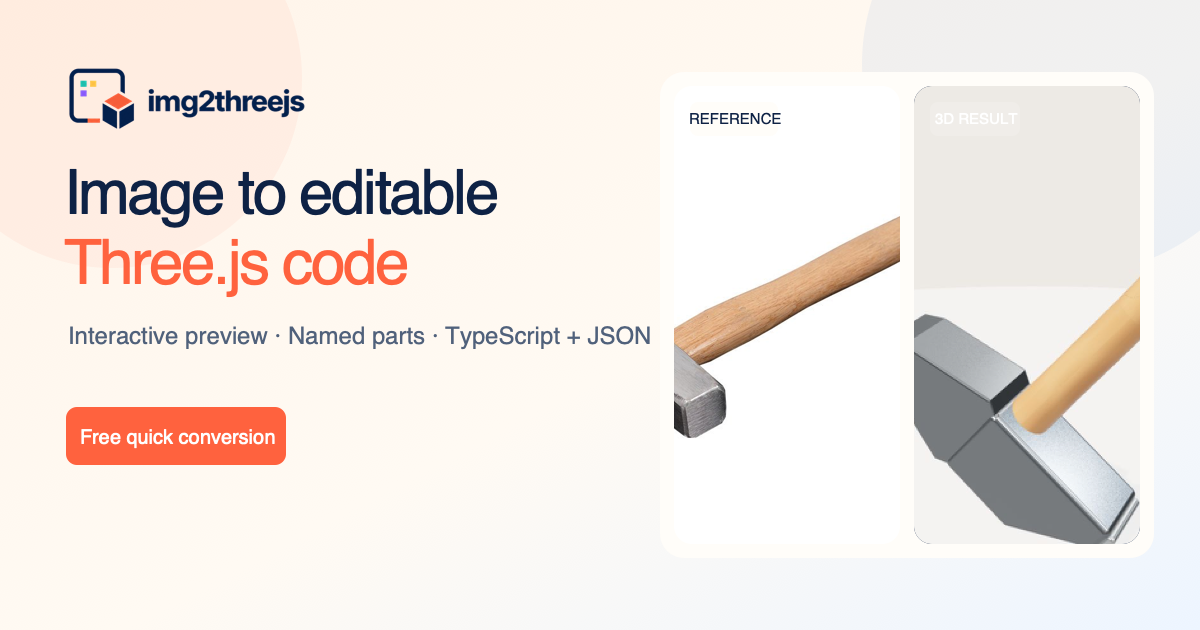
img2threejs is a free image-to-Three.js converter that transforms a single clear object image into an editable, procedural Three.js model. It's designed for developers, creative coders, and product designers seeking a practical starting point for programmable web 3D, offering unparalleled editability and integration into modern development workflows.
Key Features:
Use Cases:
img2threejs excels in scenarios where structure and editability are paramount. It's ideal for creating interactive product previews from photos, enabling easy feature highlighting, material swaps, and connecting application state to specific parts in configurators or landing-page interactions. Developers can also use it for game prop prototypes, quickly blocking out recognizable objects with named components to clarify assembly and guide later high-detail asset creation. Creative coders will appreciate the readable TypeScript output for varying dimensions, colors, and elements, fitting seamlessly into Three.js projects and Git workflows.
Pricing Information:
img2threejs operates on a freemium model. Its 'Quick mode' offers 1 free anonymous generation per day. For more complex, multi-step analysis and generation, 'Agent mode' is available, priced in credits based on estimated complexity, with the cost displayed before confirmation.
User Experience and Support:
The converter provides an intuitive workflow: upload an image, select 'Quick Generate', and preview the result directly in your browser. Users can orbit the model, switch material views, and inspect the underlying JSON specification. The output is designed to be highly readable and maintainable, allowing developers to continue refinement in their own repositories, renaming parts, adjusting dimensions, or attaching events.
Technical Details:
img2threejs generates procedural geometry assembled into a reusable Three.js hierarchy. The output is primarily in TypeScript and JSON, making it highly compatible with web development environments. The conversion process involves sending the reference image through the img2threejs server to OpenRouter and a configured downstream AI model for visual analysis and generation.
Pros and Cons:
Pros:
Conclusion:
img2threejs offers a powerful and accessible solution for transforming 2D images into editable, browser-native 3D models. Its focus on procedural generation and readable code makes it an invaluable tool for web developers and designers looking to integrate interactive 3D into their projects with maximum flexibility. Explore img2threejs today to bring your product images to life in Three.js.
Key Features:
- Converts single object images into multi-part Three.js scenes.
- Generates named components, materials, transforms, and geometry instructions.
- Provides an interactive browser preview for immediate inspection.
- Downloads readable TypeScript factory code and a structured JSON build specification.
- Focuses on creating editable output, not opaque meshes.
Use Cases:
img2threejs excels in scenarios where structure and editability are paramount. It's ideal for creating interactive product previews from photos, enabling easy feature highlighting, material swaps, and connecting application state to specific parts in configurators or landing-page interactions. Developers can also use it for game prop prototypes, quickly blocking out recognizable objects with named components to clarify assembly and guide later high-detail asset creation. Creative coders will appreciate the readable TypeScript output for varying dimensions, colors, and elements, fitting seamlessly into Three.js projects and Git workflows.
Pricing Information:
img2threejs operates on a freemium model. Its 'Quick mode' offers 1 free anonymous generation per day. For more complex, multi-step analysis and generation, 'Agent mode' is available, priced in credits based on estimated complexity, with the cost displayed before confirmation.
User Experience and Support:
The converter provides an intuitive workflow: upload an image, select 'Quick Generate', and preview the result directly in your browser. Users can orbit the model, switch material views, and inspect the underlying JSON specification. The output is designed to be highly readable and maintainable, allowing developers to continue refinement in their own repositories, renaming parts, adjusting dimensions, or attaching events.
Technical Details:
img2threejs generates procedural geometry assembled into a reusable Three.js hierarchy. The output is primarily in TypeScript and JSON, making it highly compatible with web development environments. The conversion process involves sending the reference image through the img2threejs server to OpenRouter and a configured downstream AI model for visual analysis and generation.
Pros and Cons:
Pros:
- Generates highly editable and programmable Three.js models.
- Output includes named parts, materials, and transforms for easy manipulation.
- Provides readable TypeScript and JSON, fitting into Git workflows.
- Offers a free 'Quick mode' for daily use.
- Not suitable for photogrammetry-grade surface accuracy or complex organic forms.
- Single image limits inference of hidden surfaces, scale, and exact connections.
- 'Agent mode' for advanced generation is a paid feature.
- Does not export to GLB, OBJ, FBX, or STL directly.
Conclusion:
img2threejs offers a powerful and accessible solution for transforming 2D images into editable, browser-native 3D models. Its focus on procedural generation and readable code makes it an invaluable tool for web developers and designers looking to integrate interactive 3D into their projects with maximum flexibility. Explore img2threejs today to bring your product images to life in Three.js.
Comments
Comments will be available once the project is launched.
Publisher

Launch Date2026-11-13
Platformweb
Pricingfreemium
Tech Stack
#Three.js#TypeScript#AI
Sponsors

Product Hunt Email Scraper
Scraper Email for Product Hunt Daily leaderboard and peerlist, tinylaunch, uneed.
Become a Sponsor
Get your brand featured here
Outbid
View🥇 🥈
🥈 🥉
🥉
Want this spot? Pay what you wantBoost Domain Rating - Boost Domain Rating is a platform to discover and upvote the best tech products. Find top products launching daily.
Boost Domain Rating is a platform to discover and upvote the best tech products. Find top products launching daily.
$35
DirEasy - The Best Directory Boilerplate with AI | DirEasy
The best directory boilerplate, packed with AI, Listings, Payment, Submission, CMS, Blog, Authentication, Newsletter, SEO and more.
$30
Quiz Shot - Solve Any Screenshot Question in Seconds.
AI Study Assistant that answers any screenshot question. Get free AI tutor and step-by-step math and homework help with ChatGPT.
$25