
Is Print on Demand Worth It in 2026 in India? Who Should Do POD Now
Is Print on Demand Worth It in 2026 in India? Who Should Do POD Now
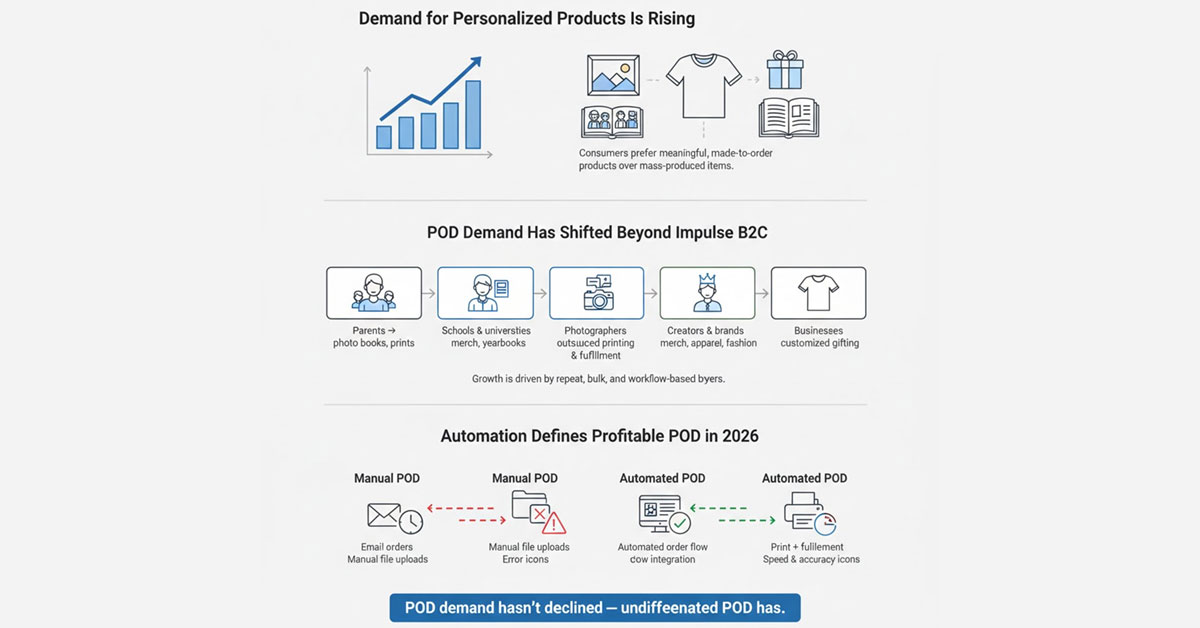
Print on Demand has been called “dead” again and again—especially in conversations around print on demand India 2026. Higher ad costs, crowded marketplaces, thinner margins, slow fulfilment, and tougher customer expectations have made many sellers wonder whether this model still has a future.
But the real question isn’t “Is POD dead?”
It’s this:
Is print on demand worth it in 2026 in India?
Is print on demand profitable in India 2026?
And if it is—who should do POD now (and who should avoid it)?
This is a print on demand India reality check—written to solve the actual query, not sell hype.
The 2026 Reality Check: POD Isn’t Dead—Generic POD Is
When people say “is print on demand dead in 2026”, they’re usually talking about the old model:
generic t-shirts and mugs
“upload designs + run ads + hope”
competing mainly on price
one store trying to sell to everyone
manual operations behind the scenes
That version is struggling in India today.
What’s growing in print on demand business India 2026 is the modern model:
personalised products and niche storefronts
repeat demand (not one-time impulse buys)
automation + web-to-print
higher AOV (average order value)
predictable buyers (families, schools, photographers, brands)
So yes—POD can still work. But not the old way.
Why Print on Demand Feels Harder in India (2026)
If POD feels tougher now, it’s not your imagination.
1) Customer acquisition costs are higher
Meta and Google ads are expensive, and buyers scroll faster. Generic POD products don’t convert without deep discounts, which makes print on demand profitable India harder if you depend only on ads.
2) Marketplaces are overcrowded
Amazon, Etsy, and social stores are full of similar listings. In many categories, design alone is no longer a real differentiator.
3) Margins get eaten quickly
Printing cost + packaging + shipping + COD fees + returns can wipe out profit, especially if your product price is low. This is where many “POD businesses” fail and assume POD is dead.
4) Operations are more demanding
Indian customers expect fast delivery, quality consistency, and real-time updates. Manual workflows that worked at 10–20 orders/day break badly at scale—making print on demand business India 2026 operationally heavy.
So, Is Print on Demand Worth It in 2026 in India?
Yes—if you build it like a system, not like a side hustle.
In 2026, POD is worth it when you have at least 3 of these 5:
You serve a clear niche (not everyone)
Your product is tied to emotion/identity (not “cool design”)
Your AOV is healthy (bundles, add-ons, upgrades)
You have repeat or bulk demand
You automate workflows (order → design → print → fulfilment)
If you don’t have these, you may still “run POD,” but profitability will be fragile.
Who Should Do POD Now in India (2026)
Here are the buyer types where print on demand India 2026 is still strong—and why.
1) Families & parents (emotion-driven, repeat demand)
If you sell memory-based products—photobooks, prints, magnets, wall décor—you’re selling something emotional. Emotional products convert better and face less price pressure.
Why it’s profitable:
repeat occasions (birthdays, anniversaries, baby milestones)
higher AOV through bundles and upgrades
less “design comparison” behavior
2) Schools & education (predictable + bulk orders)
Schools need yearbooks, merchandise, certificates, event kits, sports items. This is not impulse buying—this is planned demand.
Why it’s profitable:
bulk orders
seasonal repeat demand
easier forecasting
stronger unit economics when systemized
3) Photographers & studios (B2B-style recurring fulfilment)
Studios need albums, prints, frames, proofing workflows, consistent quality.
Why it’s profitable:
repeat client work
higher AOV products
relationship-based retention
less ad dependency
4) Creators & brands (community-based merch)
Creators with engaged audiences can sell drops and limited merch if fulfilment is smooth. In 2026, community is a stronger advantage than design alone.
Why it’s profitable:
demand already exists (audience-led)
higher conversion from trust
limited drops reduce SKU chaos
5) Corporate & institutional gifting (high value, repeat cycles)
Companies purchase in bulk for onboarding, festivals, events, employee recognition.
Why it’s profitable:
large order sizes
repeat seasonal cycles
less return pressure if QC is strong
Who Should Avoid POD (or Change Strategy)
POD is usually not worth it in 2026 if:
you only sell generic t-shirts/mugs
you compete mainly on price
you plan to rely fully on marketplaces
you have no automation and no operational team
you want “passive income” with manual processing behind the scenes
That doesn’t mean POD is dead. It means the approach is.
Is Print on Demand Profitable in India 2026?
It can be—if built correctly.
Here’s what makes print on demand profitable India in 2026:
1) Higher AOV beats low AOV
Low AOV + high shipping/COD/returns = fragile business.
Profitable POD sellers build:
bundles (e.g., prints + frame + gift pack)
add-ons (extra copies, premium paper, name personalization)
upgrades (express dispatch, premium packaging)
2) Repeat demand beats impulse demand
Impulse POD is expensive (ads + discounts).
Repeat demand is stable (families, schools, studios, corporate).
3) Systems beat manual hustle
In print on demand business India 2026, profit is not only about product—it’s about workflow.
The 2026 Playbook: How Winning POD Sellers Operate
Automation is the foundation
In 2026, automation isn’t optional. It connects:
order intake
personalisation data
design generation
print-ready output
routing + fulfilment + tracking
Without automation, growth increases errors, delays, refunds, and reprints.
Web-to-print changes conversions
Web-to-print lets customers personalize with live previews. It:
increases trust
reduces mistakes
lowers returns
improves conversion rates
supports higher pricing
Multiple storefronts beat one generic store
Successful POD sellers run different storefronts for:
family photo products
school stores
photographer portals
creator merch
corporate gifting
Same backend system—different buyer journeys.
The Biggest Mistakes That Kill POD Profitability in India
Most POD failures come from these avoidable mistakes:
selling generic products
too many SKUs (complexity without profit)
relying only on marketplaces
ads-only strategy without retention
manual operations
weak QC and slow fulfilment
competing on price instead of value
This is the real print on demand India reality check: inefficiency is the hidden cost.
Conclusion: Is POD Worth It in 2026 in India?
Yes—but only for the right sellers and the right model.
If you build print on demand India 2026 around:
niche buyers
emotional or identity-driven products
higher AOV
repeat demand
automation + web-to-print
…then POD is still one of the most scalable business models in India today.
If you build it as generic listings + manual work + price competition, you’ll feel like print on demand dead in 2026 is true.
If you’re building a modern print on demand business India 2026, the fastest way to stop “busy but not profitable” operations is to move toward automation + web-to-print.
EzyCreate is built for sellers and print businesses that want to scale POD with:
live personalization and previews (web-to-print)
automated print-ready file generation
workflow control from order to fulfilment
scalable storefronts for different customer segments
Read the full guide here: https://www.ezycreate.com/blog/is-print-on-demand-worth-it-in-2026/
Comments
Achievement


Publisher
Launch Date2026-05-21
Platformweb
Pricingfreemium
Tech Stack
##nodes##Three.js##WebGL##React##Node.js
Sponsors

Product Hunt Email Scraper
Scraper Email for Product Hunt Daily leaderboard and peerlist, tinylaunch, uneed.
Become a Sponsor
Get your brand featured here
Outbid
View🥇 🥈
🥈 🥉
🥉
Want this spot? Pay what you wantBoost Domain Rating - Boost Domain Rating is a platform to discover and upvote the best tech products. Find top products launching daily.
Boost Domain Rating is a platform to discover and upvote the best tech products. Find top products launching daily.
$35
DirEasy - The Best Directory Boilerplate with AI | DirEasy
The best directory boilerplate, packed with AI, Listings, Payment, Submission, CMS, Blog, Authentication, Newsletter, SEO and more.
$30
Quiz Shot - Solve Any Screenshot Question in Seconds.
AI Study Assistant that answers any screenshot question. Get free AI tutor and step-by-step math and homework help with ChatGPT.
$25