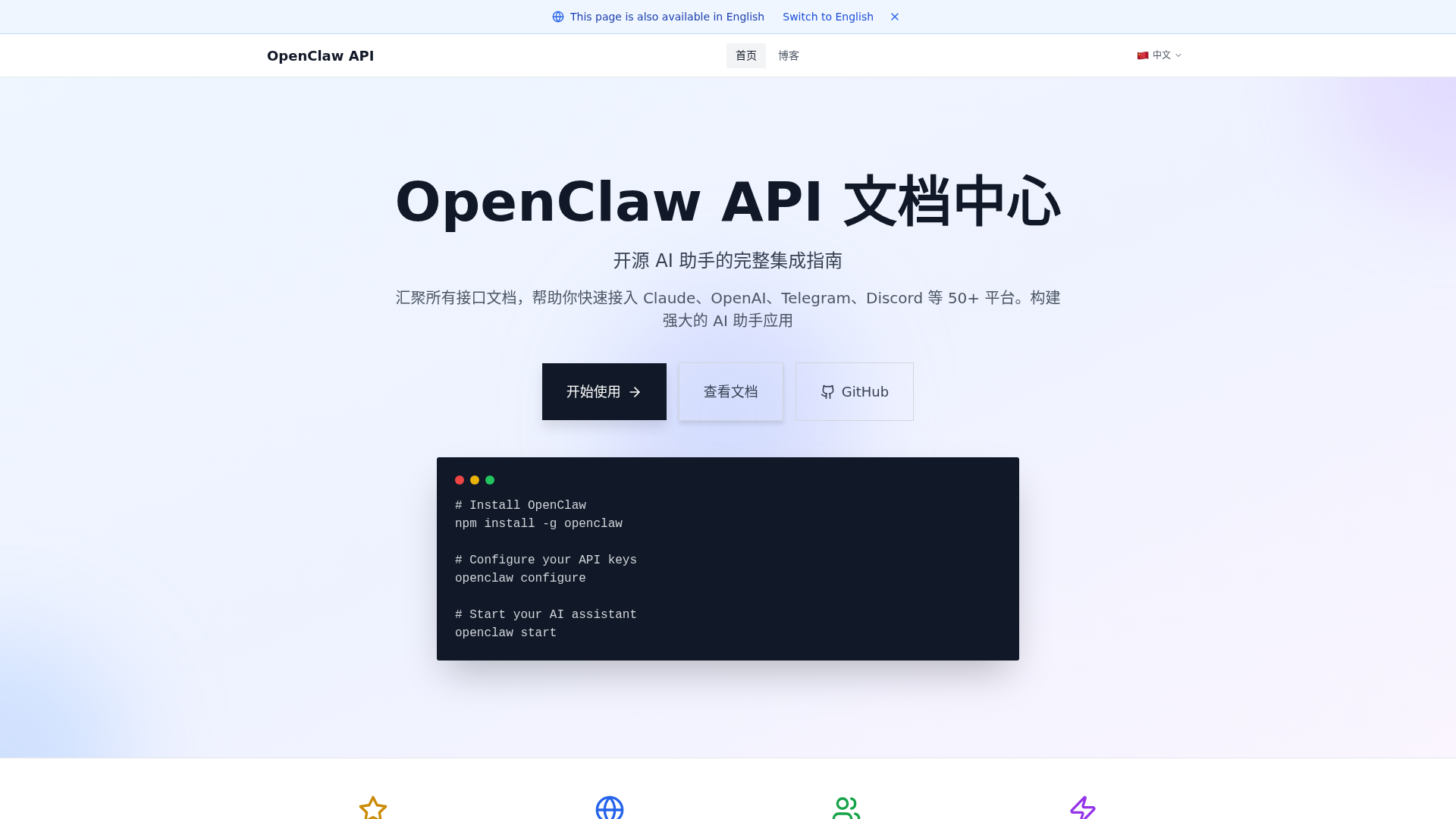
OpenClaw API is a comprehensive, open-source integration guide designed to help developers quickly build powerful AI assistant applications. It consolidates interface documentation and provides seamless integration with over 50 platforms, including leading AI models like Claude and OpenAI, and communication channels such as Telegram and Discord. This platform is ideal for developers, teams, and individuals seeking to deploy versatile and robust AI solutions.
Key Features:
- Multi-model support for Anthropic Claude, OpenAI, Google Gemini, and local Ollama.
- Extensive platform integration across 20+ communication channels like Telegram, Discord, and Slack.
- Local-first architecture ensuring data control, private deployment, and Docker isolation.
- Advanced multi-modal interaction capabilities including voice calls and real-time Canvas.
- Extensible system with plugin-like skill extensions, supporting timed tasks and Webhooks.
- Completely open-source, community-driven, and free to use.
Use Cases:
OpenClaw API empowers a wide range of applications. Individuals can leverage it to create a personalized AI assistant accessible via Telegram or WhatsApp, streamlining daily tasks and information retrieval. For teams, OpenClaw integrates AI into collaboration platforms like Slack or Discord, enhancing productivity and automating routine communications. Beyond personal and team use, OpenClaw facilitates sophisticated workflow automation. By utilizing its Webhooks and timed task interfaces, users can build intelligent systems that respond to events, manage data, and execute complex sequences, transforming how businesses operate and interact with their digital environment.Pricing Information:
OpenClaw API is completely open-source and free to use, driven by a vibrant community. This model ensures continuous updates and maintenance without any direct cost for the core platform.User Experience and Support:
The platform boasts an extremely simple installation and configuration process, allowing users to set up their first AI assistant in just three steps and five minutes. Command-line tools (npm, Docker) simplify deployment for both local experimentation and large-scale production environments. Comprehensive documentation, tutorials, and best practices are available, alongside a dedicated FAQ section and technical support to address configuration and development queries.Technical Details:
OpenClaw employs a modular architecture with standardized interfaces for LLMs, communication channels, and service tools, prioritizing high availability, security, and scalability. Its core engine natively drives major AI models, utilizing Function Calling for intelligent tool invocation. A high-performance WebSocket Gateway ensures millisecond-level synchronization across devices. Security is paramount, with credential management via environment variables or encrypted JSON5, and an `openclaw doctor` tool for configuration risk scanning. It also supports Ollama for offline AI processing.Pros:
- Open-source and free.
- Extensive integration with 50+ platforms and models.
- Local-first architecture for data privacy.
- Highly extensible with plugin-like skills.
- Robust security practices for credentials.
Cons:
- Requires command-line interaction for setup.
- Learning curve for advanced customization and plugin development.
- No explicit GUI for initial setup (though command-line is simple).
Conclusion:
OpenClaw API stands out as a powerful, flexible, and secure open-source solution for integrating AI assistants across a vast ecosystem of models and communication platforms. Its ease of integration, combined with advanced features and a strong community, makes it an invaluable tool for developers. Explore OpenClaw API today to unlock the full potential of AI in your applications.Comments
Publisher

Launch Date2026-03-07
Platformapi
Pricingfree
Tech Stack
#npm#Docker#WebSocket
Sponsors

Product Hunt Email Scraper
Scraper Email for Product Hunt Daily leaderboard and peerlist, tinylaunch, uneed.
Become a Sponsor
Get your brand featured here
Outbid
View🥇 🥈
🥈 🥉
🥉
Want this spot? Pay what you wantBoost Domain Rating - Boost Domain Rating is a platform to discover and upvote the best tech products. Find top products launching daily.
Boost Domain Rating is a platform to discover and upvote the best tech products. Find top products launching daily.
$35
DirEasy - The Best Directory Boilerplate with AI | DirEasy
The best directory boilerplate, packed with AI, Listings, Payment, Submission, CMS, Blog, Authentication, Newsletter, SEO and more.
$30
Quiz Shot - Solve Any Screenshot Question in Seconds.
AI Study Assistant that answers any screenshot question. Get free AI tutor and step-by-step math and homework help with ChatGPT.
$25