Manifest Review - Open Source LLM Router for OpenClaw AI Agents
Welcome to this comprehensive Manifest Review! 🚀
Ever opened your OpenClaw API bill and wondered where all that money went? 😱 You're not alone. Manifest is here to rescue your wallet while keeping your AI agents just as smart.
Manifest is an open-source OpenClaw plugin that intelligently routes your AI agent queries to the most cost-effective model available. Think of it as a traffic cop for your AI requests—directing simple questions to cheap models and complex problems to the big guns. If you're using OpenClaw AI agents daily and watching your API bills spiral out of control, Manifest offers a pragmatic solution to cut costs without compromising output quality. 💰
What makes this LLM router truly remarkable is its ability to analyze each query locally in under 2 milliseconds (faster than you can blink!), then automatically route it to the appropriate model based on complexity. With support for over 600 models across four intelligent routing tiers, Manifest ensures your OpenClaw agents always use the right tool for the job—whether that's a lightweight model for simple greetings or a reasoning-capable powerhouse for complex logic problems.
In this Review, we'll dive deep into how Manifest's intelligent routing system works, explore its budget control features, and see why open-source transparency matters for AI Agent workflows. Let's get started! 🎉
Key Features Overview
Manifest provides a comprehensive OpenClaw plugin solution for intelligent AI routing with these core capabilities:
- Intelligent 4-tier routing - Automatically scores queries across 23 dimensions and routes to Simple, Standard, Complex, or Reasoning models
- Open source and free - Fully Open Source with transparent routing logic, self-hostable option, and no black boxes
- 600+ models available - Access to more than 600 LLM models from major providers in one unified interface
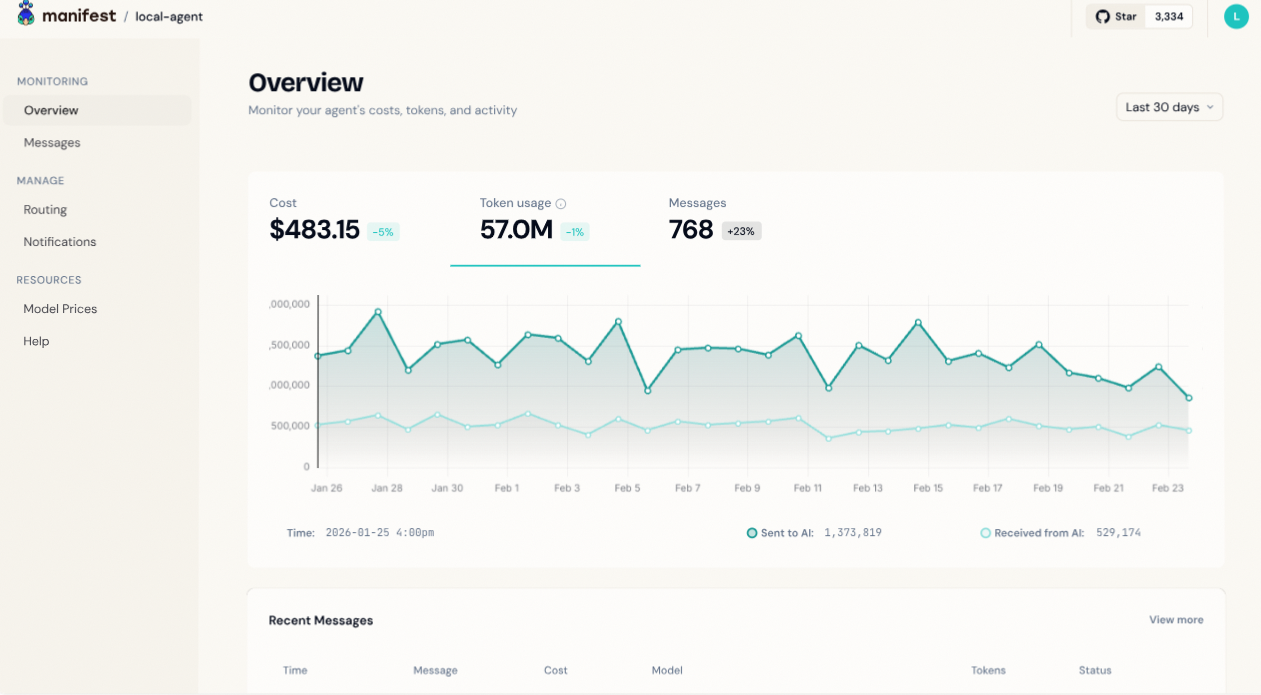
- Real-time usage tracking - Monitor tokens, costs, and model usage through a comprehensive dashboard
- Budget limits and notifications - Set alerts and hard blocks to prevent API spending from exceeding thresholds
- Local privacy mode - All query scoring happens on your machine with telemetry metadata only in cloud mode
- Native OpenClaw plugin - One-command installation with seamless OpenClaw integration
- OAuth connections and API key support - Flexible authentication options for enhanced security
- Fallback system - Automatic model fallback ensures reliability when primary models are unavailable
- OpenTelemetry standard - Uses industry-standard telemetry format for data portability and control
These features work together to create a powerful LLM routing solution that optimizes both cost and performance for OpenClaw AI Agents.
The Problem: Wasted OpenClaw API Costs
OpenClaw routes everything to the same model by default—meaning you're paying premium rates for simple tasks that cheap models could handle just fine. This inefficiency causes API bills to spiral as your AI Agent usage grows.
The Smart Routing Solution
Manifest intercepts each OpenClaw request and routes it to the most cost-effective model that can handle the task. Instead of one-size-fits-all routing, Manifest analyzes each query's requirements and matches it with an appropriate model tier. This intelligent approach can reduce OpenClaw costs by up to 70-90% depending on your usage patterns without compromising output quality.
4-Tier Routing System Explained
Manifest's core innovation is its intelligent 4-tier routing system:
Simple Tier
Greetings, definitions, and short factual questions get routed to the cheapest available models. Perfect for basic interactions like "hello," "what is AI," or simple clarifications at minimal cost.
Standard Tier
General coding help and moderate complexity questions require better quality at reasonable cost. This handles most day-to-day OpenClaw queries—the sweet spot for most AI Agent interactions.
Complex Tier
Multi-step tasks, large context processing, and code generation require best-quality models. For deep analysis, codebase comprehension, or extended context windows, Manifest routes these to powerful models that deliver the quality you need.
Reasoning Tier
Formal logic, mathematical proofs, and multi-constraint problems require reasoning-capable models only. Manifest automatically detects signals like formal logic keywords and routes these challenging queries appropriately.
How Scoring Works
Manifest's routing intelligence comes from its sophisticated scoring algorithm that evaluates each query across 23 dimensions in under 2 milliseconds. The routing engine considers four key factors to make optimal routing decisions:
- Task Type - Analyzes whether the request involves code, text, classification, reasoning, or other task categories
- Required Quality Level - Evaluates the quality needed based on the prompt complexity and context
- Current Model Pricing - Factors in real-time pricing across all available providers to select the most cost-effective option
- User Preferences and Constraints - Respects your configured preferences, budget limits, and routing constraints
Keyword-Based Analysis (13 Dimensions)
Scans prompts for patterns like "prove," "write function," "what is," and hundreds of other signals to determine complexity and tier assignment.
Structural Analysis (10 Dimensions)
Analyzes token count, nesting depth, code-to-prose ratio, tool count, and conversation depth. A short, simple question scores differently than a multi-page code snippet.
Weighted Scoring and Confidence
Each dimension carries a specific weight. The weighted sum maps to a tier through threshold boundaries, while a confidence score (0-1) indicates how clearly the request fits its assigned tier.
Session Momentum
Manifest remembers the last 5 tier assignments with a 30-minute TTL. Short follow-ups like "yes" or "do it" inherit momentum, preventing unnecessary tier drops that could disrupt conversation flow.
Usage Tracking and Dashboard
Monitor tokens, costs, messages, and model usage at a glance through an intuitive real-time dashboard.
Comprehensive Metrics
Track token consumption per model, cost analysis by provider, message frequency, and routing efficiency. See exactly how much money Manifest's intelligent routing is saving you.
OpenTelemetry Integration
Manifest uses the OpenTelemetry standard for telemetry collection and export. This industry-standard format means you own your data and can integrate it with other monitoring tools. Whether you're using cloud mode or local mode, OpenTelemetry ensures data portability and control.
Budget Control with Limits and Notifications
Set notifications and limits to prevent API spending from exceeding thresholds, giving you peace of mind and preventing unexpected charges.
Notification Rules
Create rules that alert you when spending approaches thresholds. Configure based on metrics (tokens or cost), time periods (hour, day, week, or month), and specific thresholds. Manifest sends email alerts via supported providers like Mailgun, Resend, and SendGrid.
Block Rules
For stricter control, set block rules that return HTTP 429 and stop requests when thresholds are exceeded. This hard stop prevents runaway spending from unexpected usage spikes.
Per-Agent Configuration
Configure limits and notifications per agent for granular control. Set different budget thresholds for production vs experimental agents, or allocate spending limits across teams and projects.
Cloud vs Local Mode
Manifest runs in two deployment modes: Cloud (hosted at app.manifest.build) and Local (embedded on your machine). Both share the same features — the difference is where data lives and how authentication works.
Cloud vs Local Comparison
| Feature | Cloud Mode | Local Mode |
|---|---|---|
| Setup | Sign up + API key | Zero config |
| Data Storage | PostgreSQL (hosted) | SQLite on your machine |
| Dashboard | app.manifest.build | http://127.0.0.1:2099 |
| Authentication | Email/password or OAuth (Google, GitHub, Discord) | Auto-login (loopback trust) |
| Multi-device | Yes — access from any browser | No — localhost only |
| API Key | Generated in dashboard (mnfst_...) | Auto-generated (mnfstlocal...) |
| Email Alerts | Built-in (platform mail) | Requires provider config (Mailgun/Resend/SendGrid) |
| Telemetry Interval | ~30 seconds | ~10 seconds |
| Privacy | Metadata only (no message content) | 100% on your machine |
| Cost | Free | Free |
When to Use Cloud Mode
Choose Cloud mode if:
- You work across multiple machines
- You want email alerts without configuring a mail provider
- You want a managed experience with no local server
When to Use Local Mode
Choose Local mode if:
- Privacy is paramount — no data leaves your machine
- You don't need multi-device access
- You prefer zero-config, offline-capable tooling
Switching Between Modes
You can switch between Cloud and Local modes at any time using simple configuration commands. Note that switching modes does not migrate data — Cloud and Local have separate databases.
Getting Started
Installation is straightforward. Simply run openclaw plugins install manifest to add Manifest as an OpenClaw plugin. Local mode works out of the box with zero configuration. For cloud mode, sign up at app.manifest.build to get your API key, then configure the plugin to start tracking your OpenClaw costs across devices.
Manifest vs OpenRouter
When comparing Manifest to OpenRouter, several key differences emerge that make Manifest particularly attractive for OpenClaw users. Here's a direct comparison based on Manifest's official documentation:
| Feature | Manifest | OpenRouter |
|---|---|---|
| Open Source | Yes - Fully open source with transparent code | No - Proprietary solution |
| Self-Hostable | Yes - Deploy on your own infrastructure | No - Requires using their hosted service |
| Privacy | Metadata only (or 100% local) | Full request proxied |
| Routing Logic | Transparent, 23-dimension scoring | Black box |
| Cost | Free - No routing fees | Per-token markup |
| Dashboard | Built-in | Separate (requires additional setup) |
| OpenClaw Integration | Native plugin | Requires configuration |
Open Source Advantage
Manifest is fully open source, while OpenRouter is proprietary. This open-source approach means you can inspect the routing logic, extend functionality, or self-host entirely. No black boxes—complete transparency into how your OpenClaw queries are routed.
Self-Hostability
Manifest is self-hostable, giving you complete control over your infrastructure and data. OpenRouter requires using their hosted service, which may not meet all compliance or privacy requirements for enterprise OpenClaw deployments.
Privacy Differences
Manifest collects only metadata (or runs 100% local), while OpenRouter proxies full requests. For OpenClaw users handling sensitive information, Manifest's privacy-by-architecture approach provides superior data protection.
User Ownership Philosophy
Manifest believes that users should own the routing layer rather than trusting opaque, proprietary proxies that have access to your message content and may have provider biases. This philosophy drives Manifest's commitment to transparency, open source, and user control.
Native OpenClaw Integration
Manifest works as a native OpenClaw plugin requiring minimal configuration. OpenRouter requires additional setup and doesn't integrate as seamlessly with the OpenClaw ecosystem.
Cost Structure
Manifest is free to use, while OpenRouter applies per-token markups. For OpenClaw users focused on cost optimization, Manifest's zero-cost routing delivers significant savings.
Final Review Summary
Manifest is an essential tool for regular OpenClaw AI agent users. Its intelligent 4-tier routing system analyzes queries in under 2 milliseconds and routes them to the most cost-effective model across 600+ options, delivering up to 90% cost savings. For individual users using OpenClaw AI agents daily and watching their API bills spiral, Manifest provides measurable savings—potentially hundreds or thousands of dollars annually. 💵
Combined with real-time dashboard visibility, flexible budget controls, and comprehensive authentication support, Manifest provides a complete LLM routing solution. Best of all, it's completely free and open source with full self-hosting capabilities. Zero routing fees, zero hidden costs—just pure savings. 🎁
Ready to cut your OpenClaw costs by up to 90%? 👉 Try it now and start saving today! Your wallet will thank you. 😊
Tags
# Review# Manifest# OpenClaw# AI# LLM# routing# open source# Agents# AI Agent# LLM Router# OpenClaw plugin# AI cost optimization# API cost reduction# AI agent routing# budget control# token tracking# OpenTelemetry# self-hosted AI router# AI model routingAtoms AI Review - AI-Powered Multi-Agent Platform for No-Code App Building
MindFusion Timetable Plugin Review - WordPress Event Schedule Solution
Follow for new blogs
Subscribe to our blog
Subscribe to Newsletter
Subscribe to our newsletter to get the best products weekly.